
Aluminum vs Plastic Intake: Technical Reliability and Performance
Aluminum vs plastic intake selection is a critical engineering decision that determines the thermal efficiency and long-term reliability of a performance vehicle. For B2B distributors and professional tuning facilities, understanding the material properties of aluminum vs plastic intake systems is essential for reducing warranty claims and ensuring consistent power delivery under high-boost conditions.
1. Thermal Conductivity and Heat Dissipation in Aluminum vs Plastic Intake
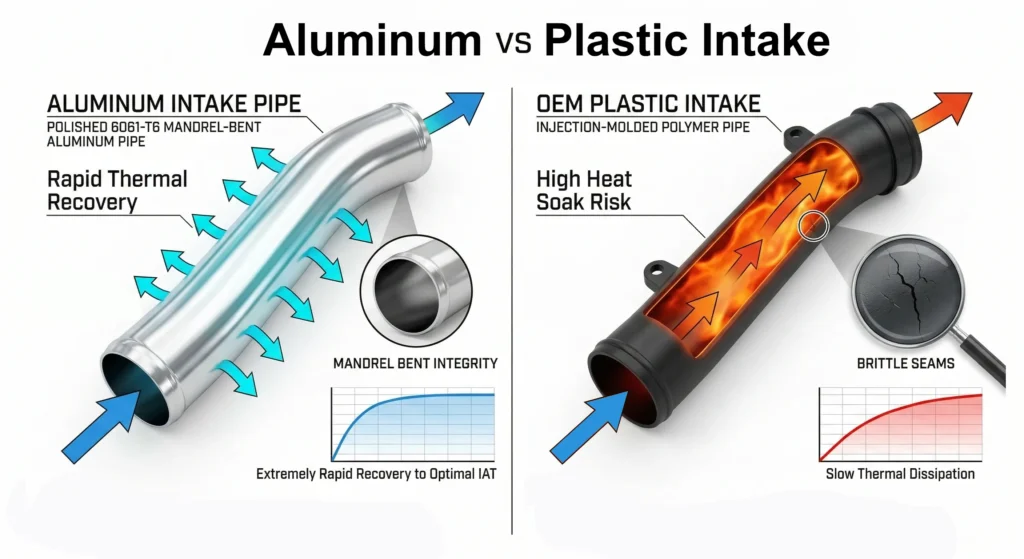
The primary technical factor in the aluminum vs plastic intake comparison is heat management. While plastic acts as an insulator, it suffers from a phenomenon known as “heat soak.” Once a plastic intake reaches a high temperature, it retains that thermal energy, pre-heating the incoming air charge.
Aluminum, conversely, has a significantly higher Thermal Conductivity. While it absorbs heat quickly, it also dissipates it much faster once ambient air passes over the intake surface. This rapid thermal exchange is critical for maintaining a denser air charge. According to the principles of Specific Heat Capacity, aluminum allows the engine to recover its optimal intake air temperature (IAT) much faster after a period of idling.
2. Structural Integrity of Aluminum vs Plastic Intake Systems
For high-performance applications involving increased boost pressure, the aluminum vs plastic intake choice becomes a matter of structural engineering. Factory plastic intakes are often constructed from multiple injection-molded pieces bonded together. Under extreme heat and pressure, these seams can become failure points.
Professional-grade aluminum intakes are constructed from 6061-T6 aluminum. This material maintains its structural integrity regardless of the internal pressure or external temperature. For high-boost gasoline or diesel engines, aluminum ensures that the intake pipe will not collapse or expand, providing a consistent cross-sectional area for airflow at all times.
3. Internal Surface Dynamics and Mandrel Bending
A critical manufacturing advantage in the aluminum vs plastic intake discussion is the internal finish of the pipe. Plastic intakes often have internal ridges from the molding process which create air turbulence.
Performance aluminum intakes utilize Mandrel Bending technology. This process uses an internal solid mandrel during the bend to ensure the pipe maintains a perfectly circular cross-section. This smooth internal surface is vital for promoting laminar flow, reducing air resistance, and maximizing the velocity of the air as it enters the throttle body.

4. Manufacturing Precision and R&D Capabilities
In the B2B sector, the shift from aluminum vs plastic intake is also driven by the speed of development. Utilizing industrial 3D scanning and R&D capabilities, aluminum intakes can be manufactured with extreme precision to fit complex engine bays.
Aluminum allows for CNC-machined sensor bungs to be welded directly onto the pipe with zero tolerances. This level of precision ensures that the sensor signal remains stable and accurate, a feat that is difficult to achieve with the standardized tolerances of mass-produced plastic housings.
5. B2B Professional Value Proposition
Finally, the aluminum vs plastic intake choice carries significant weight in the professional value proposition. A high-quality aluminum intake provides an immediate visual upgrade to the engine bay, signaling professional-grade modification.
From a business perspective:
- Durability: Aluminum is a “lifetime” component that does not degrade, unlike plastic which can become brittle over time.
- Profitability: The perceived value of a CNC-machined aluminum system is significantly higher, allowing for better margins for both the manufacturer and the retail facility.
Conclusion
While plastic is an effective material for cost-sensitive OEM applications, it cannot match the thermal recovery and structural stability of professional-grade aluminum. In the technical hierarchy of aluminum vs plastic intake, the aluminum system remains the superior choice for high-performance builds where precision and power consistency are the primary objectives.
For more technical resources and wholesale sourcing data, return to our B2B Strategic Hub.