
Air Filter vs Air Intake System: A Fluid Dynamics Evaluation
In the performance automotive industry, the technical distinction between a high-flow replacement filter and a complete induction overhaul is a critical factor in vehicle optimization. While many retail consumers view the air filter vs air intake system debate through the lens of price, professional tuning shops must evaluate these components based on fluid dynamics and induction efficiency.
For B2B distributors, the ability to explain why a standalone filter cannot match the performance gains of a fully engineered intake system is essential for establishing technical authority and maximizing service value.
1. Surface Area and Face Velocity Geometry
The initial comparison in the air filter vs air intake system discussion involves the geometry of the filtration media. A standard “drop-in” high-flow filter is physically limited by the dimensions of the OEM airbox. This constraint restricts the total surface area available for air passage, forcing the engine to draw air through a smaller aperture at a higher “face velocity.”
A complete air intake system utilizes an oversized conical or inverted-top filter. This design significantly expands the filtration surface area. According to the principles of Fluid Dynamics, increasing the surface area reduces the resistance (pressure drop) across the media. This allows for a higher volume of air to enter the system with less parasitic drag, ensuring the engine expends less energy during the induction stroke.
2. Laminar Flow vs. Internal Pipe Turbulence
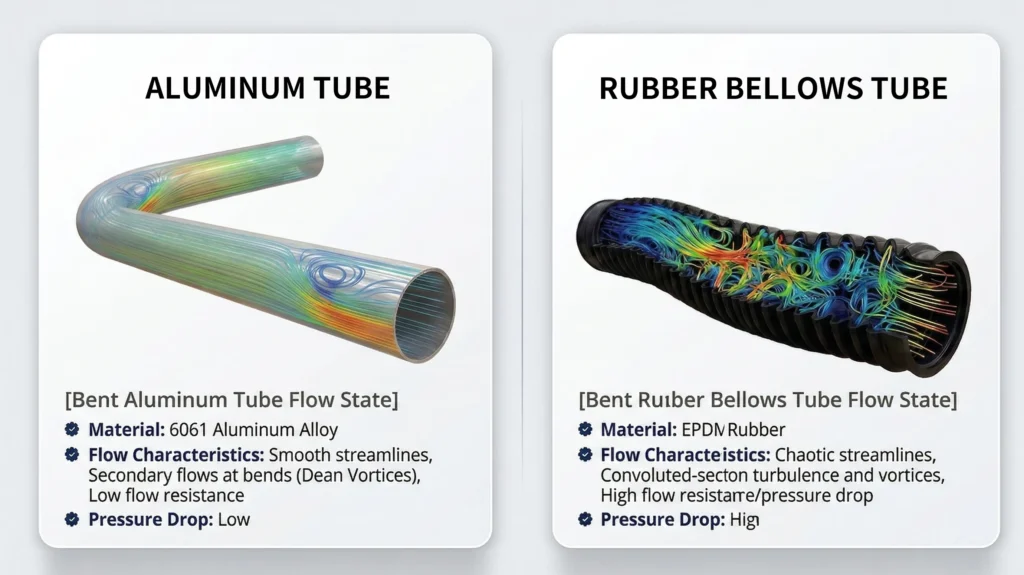
The most significant advantage of an intake system over a simple air filter is the management of air velocity and direction. Factory induction tracts are frequently constructed from corrugated rubber or ribbed plastic hoses designed to accommodate engine torque movement. These uneven internal surfaces create massive “skin friction” and air turbulence.
When evaluating air filter vs air intake system, the full system replaces these turbulent factory hoses with smooth-bore, mandrel-bent aluminum or carbon fiber piping. This structural upgrade promotes Laminar Flow, where air moves in parallel layers with minimal disruption. By ensuring the air column reaches the throttle body as a cohesive, high-velocity mass, the system dramatically improves throttle response and volumetric efficiency—gains that a simple filter swap cannot achieve within a factory corrugated pipe.
3. The Impact of Pressure Drop on Volumetric Efficiency
Every internal combustion engine is limited by its ability to achieve high Volumetric Efficiency (VE). A stock air filter, even a high-flow version, remains part of a factory induction tract that was engineered with noise suppression (NVH) as a priority. These systems often include baffled resonators that create bottlenecks in the airflow path.
A professionally engineered air intake system eliminates these aerodynamic restrictions. By providing a direct, consistent-diameter path from the atmosphere to the manifold, the system minimizes the “pressure drop” across the entire induction cycle. This allows the cylinders to fill more completely during the intake stroke, directly resulting in increased torque and horsepower across the upper RPM range where factory restrictions are most prevalent.
4. Acoustic Tuning and Induction Frequency
Beyond raw flow rates, the air filter vs air intake system comparison involves acoustic engineering. Factory airboxes are designed to muffle the sound of the intake air, which often involves “trapping” the air in chambers. While this reduces noise, it also slows down air velocity.
An aftermarket induction system is tuned to allow for a more aggressive induction note, which is the result of unrestricted airflow. For the professional shop, this sensory feedback is a vital part of the value proposition. It provides the customer with audible proof of the increased air velocity and mechanical efficiency, reinforcing the perceived quality of the installation and the hardware itself.
5. B2B Strategic Sourcing and Upsell Logic
From a business perspective, the air filter vs air intake system transition is a strategic move toward higher profitability.
- Engineering Quality: A complete system is a “closed-loop” engineering solution. It ensures that the filter, the piping, and the MAF sensor housing are all calibrated to work together, reducing the risk of “Check Engine Lights” that often occur when mixing high-flow filters with turbulent factory ducting.
- Margin Optimization: For the distributor and the tuning facility, selling and installing a full system represents a significantly higher average transaction value compared to a simple filter replacement. It positions your brand as a provider of comprehensive performance solutions rather than a vendor of maintenance parts.
Conclusion
While a high-flow replacement filter is a functional minor upgrade, it is fundamentally limited by the aerodynamic bottlenecks of the factory induction tract. In the technical hierarchy of air filter vs air intake system, the complete induction kit remains the only professional choice for serious performance engineering.
For more strategic assets and sourcing data, return to our [B2B Strategic Hub] .