
Dry vs. Oiled Air Filter: A Technical Reliability and Maintenance Analysis
In the professional automotive aftermarket, the choice between different filtration media is a critical factor for long-term vehicle reliability. For B2B distributors and professional tuning facilities, the dry vs oiled air filter debate centers on more than just initial airflow; it involves mass air flow (MAF) sensor safety and operational maintenance costs.
As precision engineering becomes more prevalent in modern ECU-controlled engines, understanding the material science behind these filtration types is essential for reducing warranty claims and ensuring customer satisfaction.
1. Filtration Mechanisms and Material Science
The fundamental difference in the dry vs oiled air filter comparison lies in the physical and chemical capture of particulates. Oiled filters typically utilize multiple layers of cotton gauze saturated with a specialized tackifier. This oil acts as a physical magnet for dust, utilizing a process known as “impingement” to trap debris.
Dry filters, conversely, utilize advanced multi-layered synthetic media. These fibers rely on “interception” and “diffusion” to capture contaminants without the need for a liquid additive. According to the engineering standards of Air Filtration, synthetic dry media provides a highly consistent pore size, which ensures that filtration efficiency remains stable throughout the service life of the component.
2. Protection of Mass Air Flow (MAF) Sensors
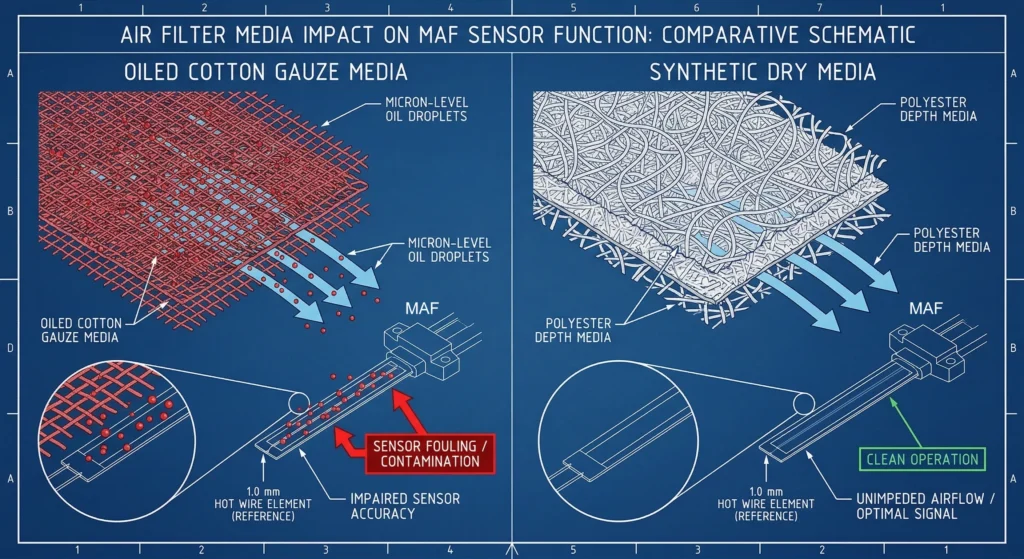
For professional installers, the most significant risk in the dry vs oiled air filter choice is sensor contamination. Modern MAF sensors utilize a delicate “hot wire” to measure air density. If an oiled filter is improperly serviced or over-saturated, microscopic oil droplets can migrate into the intake tract and coat the sensor wire.
This contamination creates a thermal barrier on the sensor, leading to inaccurate air-mass calculations. This results in fuel trim errors, reduced engine performance, and “Check Engine Lights” (CEL). For high-volume distributors, dry synthetic filters are often the preferred choice because they eliminate the risk of oil-related sensor failure, thereby reducing the burden of technical support and post-sale returns.
As illustrated in the technical comparison below, the risk of oil migration is a primary factor in the dry vs oiled air filter selection process for modern ECU-managed vehicles.
3. Maintenance Cycles and Long-Term ROI
When evaluating dry vs oiled air filter options for a commercial fleet or a performance workshop, the complexity of maintenance must be considered. Oiled filters require a labor-intensive multi-step process: cleaning, thorough drying, and precise re-oiling. Any error in this sequence can compromise the filter’s effectiveness.
Dry filters offer a much simpler maintenance profile. High-performance dry media can typically be cleaned using low-pressure compressed air or a vacuum, requiring no chemical re-treatment. This simplicity reduces the probability of end-user error. From a B2B perspective, recommending dry media increases the “Return on Investment” by lowering the total cost of ownership and simplifying the service requirements for the client.
4. Environmental Resilience and Filtration Stability
The performance of dry vs oiled air filter media is also influenced by environmental conditions. Synthetic dry filters are generally more resilient to high-humidity environments and extreme temperature fluctuations common in high-performance engine bays. Oiled cotton media can lose its effectiveness if the oil evaporates or becomes excessively viscous in extreme cold or dusty desert conditions.
Furthermore, synthetic media maintains its structural integrity over more cleaning cycles. While cotton gauze can eventually fray or degrade, Synthetic Fibers are engineered for durability, ensuring that the filter remains a reliable barrier against particulates throughout its operational life.
5. Volumetric Efficiency and Flow Consistency
While oiled filters historically held a reputation for higher peak flow rates, modern dry media has largely closed the performance gap. In a technical dry vs oiled air filter flow test, a multi-layer dry synthetic filter provides more than enough CFM (Cubic Feet per Minute) for most Stage 2 and Stage 3 performance builds.
Crucially, dry filters tend to maintain their flow rates more consistently as they accumulate dust. Oiled filters can experience a rapid increase in resistance as dust particles mix with the oil to form a restrictive “crust,” whereas dry media utilizes depth-loading to trap particles within the fiber layers without prematurely choking the engine.
Conclusion
While both media types have their place in the industry, the modern B2B landscape is shifting toward dry synthetic filtration. In the technical evaluation of dry vs oiled air filter, the dry filter provides superior sensor safety, easier maintenance, and more consistent long-term performance—making it the logical choice for professional-grade performance inventory.
For more technical resources and wholesale sourcing data, return to our B2B Strategic Hub.